“We are accountable for and to not only specific patterns of marks on bodies — that is, the differential patterns of mattering of the world of which we are a part — but also the exclusions that we participate in enacting. Therefore accountability and responsibility must be thought of in terms of what matters and what is excluded from mattering.”
— Karen Barad, Meeting the Universe Halfway: Quantum Physics and the Entanglement of Matter and Meaning. 2006.
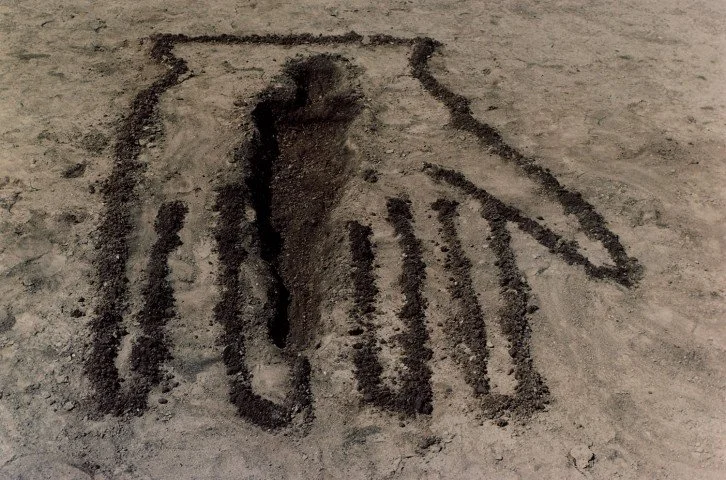
Mendieta, Ana. Silueta Works in Mexico. 1973–1977 (estate print 1991). Color photograph, 32.7 x 49.21 cm. Museum of Contemporary Art, Los Angeles. www.moca.org.
Feminist Material
As human beings, we are not outside observers or static spectators, nor are we the only intentional actors in the world. We are, however, inherently responsible for co-creating what is. In Meeting the Universe Halfway, Karen Barad proposes a framework she calls agential realism, in which matter is not passive or inert, but agentive—deeply entangled with mind, body, and the built environment. Within this framework, matter is not something acted upon; it is something that participates, continually reconfiguring the conditions through which the world comes to matter.
The built environment is matter, and it came to be through the co-creation of many human and nonhuman forces. This does not merely mark the inseparability of the observer and observed—it names the ontological inseparability of the builder and the built.# Within matter, within our walls, is the sedimenting of histories and the practices through which they were made. Matter carries within itself the traces of its becoming, holding the layered conditions of its production and the hands, known and unknown, that brought it into being.
To think through matter in this way is also to rethink time. The past and the future are not fixed or separate conditions, but are continuously folded into one another. What we encounter in the present is not a stable past, but an active entanglement—one that extends across temporalities, carrying histories forward while remaining open to change.
This understanding resonates with Michel Serres’s conception of time as nonlinear, a manifold in which what is ancient can reappear in the present not as something distant, but as something newly alive. Time does not move cleanly forward; it accumulates, overlaps, and persists.#
This layered temporality is inseparable from how we understand agency. If time is not singular, then neither is authorship. Bruno Latour’s rethinking of agency dissolves the boundary between human and nonhuman actors, suggesting that what we understand as the built environment is not the result of a singular figure, but of a network of relations. Materials, tools, labor, environment, and time all participate in the making of what exists. Agency, therefore, cannot be located in one body or one moment—it is distributed across the network of interactions that brought the building into being.
This understanding returns us to the built environment itself. Buildings are not singular objects; they are accumulations. They layer repair, transformation, use, and care across time. As even Viollet-le-Duc acknowledged, few buildings were ever constructed at one moment without undergoing change. And yet, within dominant Western frameworks of preservation, the value of matter has been determined not by what it holds, but by who has been recognized as owning it.
To preserve within this framework is therefore, not a neutral act. It is a decision about what will matter and what will be excluded from mattering. It is a stabilization of one narrative among many possible ones. Preservation, in this sense, participates in shaping not only how the past is remembered, but how the future will come to understand that past.
“Meaning is not a property of individual words or groups of words but an ongoing performance of the world in its differential dance of intelligibility and unintelligibility. In its causal intra-activity, part of the world becomes determinately bound and propertied in its emergent intelligibility to another part of the world, while lively matterings, possibilities, and impossibilities are reconfigured.”
Feminist materialist thought has long challenged the notion that matter is passive, inert, or separate from human meaning. Historically, women were understood to be closer to the material world—through textiles, domestic labor, and forms of care—but this proximity was not recognized as knowledge. Instead, it was used to justify subordination, reinforcing the idea that both women and matter were passive, fixed, and without agency. These were not separate ideas, but the same logic applied in different directions.
To understand this entanglement is to recognize that every interaction with the material world carries ethical weight. #
Ethics, in this sense, is not simply about the consequences of our actions, but about the ongoing material reconfigurations in which we are always already involved. To act is to participate in the becoming of the world. Every decision—what to preserve, what to restore, what to discard—becomes part of this process.
In this context, preservation can no longer be understood as an act of freezing or stabilizing the past. It must instead be understood as an ongoing negotiation with material, time, and history. To preserve is not to fix meaning, but to remain responsive to what the material holds and what it continues to become.
This requires a shift away from viewing the built environment as a static object and toward understanding it as a dynamic field of relations. The walls we encounter are not singular surfaces, but accumulations of labor, repair, care, and transformation. They are marked by the hands that have built, maintained, and altered them over time, whether or not those hands have been recorded.
To approach preservation through this lens is to recognize that what has been excluded from the archive may still exist within the material itself. The histories that were not written down may still persist—in the surface, in the marks, in the irregularities, and in the traces of use that remain.
To preserve, then, is not to freeze. It is to acknowledge, to listen, and to respond.
“Rooms are shells, they are skins. Peel off one skin after the other, discard it: the repressed, the neglected, the wasted, the lost, the sunken, the flattened, the desolate, the reversed, the diluted, the forgotten, the persecuted, the wounded.”
— Heidi Bucher
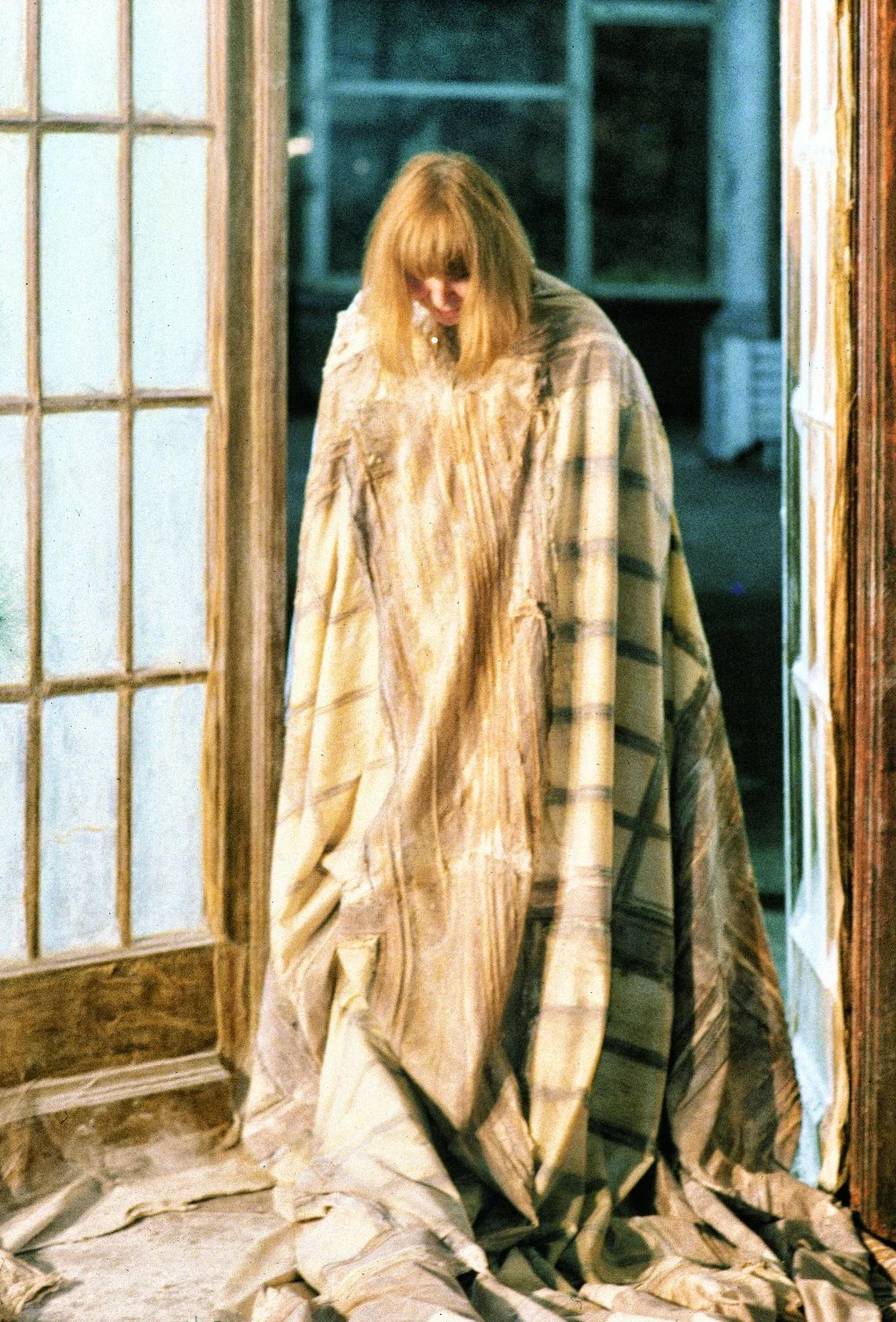
“Heidi Bucher, Metamorphoses II | Kunstbulletin.”
Heidi Bucher (Winterthur, 1926–1993) understood the surface as something to be read, not simply seen. Beginning in the mid-1970s, the Swiss artist developed a practice of applying liquid latex directly to the floors, walls, and architectural features of domestic and institutional spaces — allowing it to dry and harden before peeling it away in large, suspended sheets she called Raumhäute, or room skins. The process was slow, physical, and entirely dependent on contact. The skin received the surface. The surface gave itself up.
The spaces Bucher chose were never incidental. She skinned the Gentlemen’s Study in her parents’ house — a room historically reserved for the male members of the family — symbolically replacing the patriarchal structure with the membrane she removed. She skinned the rooms of a psychiatric clinic that had treated the alleged hysteria patient Anna O., later known as the women’s rights activist Bertha Pappenheim. Each site carried both private and public weight and the skins carried it forward.
“Our memory always extends to the limits of the space we have perceived,” Bucher noted, “Everything that is remembered thus lies in a spatial shell that may be regarded as the last surface.” The lived, the past, gets caught in the cloth and gets stuck. In the process of peeling, time dimensions fall into one another. “We slowly loosen the layers of rubber, the skin, and pull the yesterday into the present. The images are the images of tomorrow.”
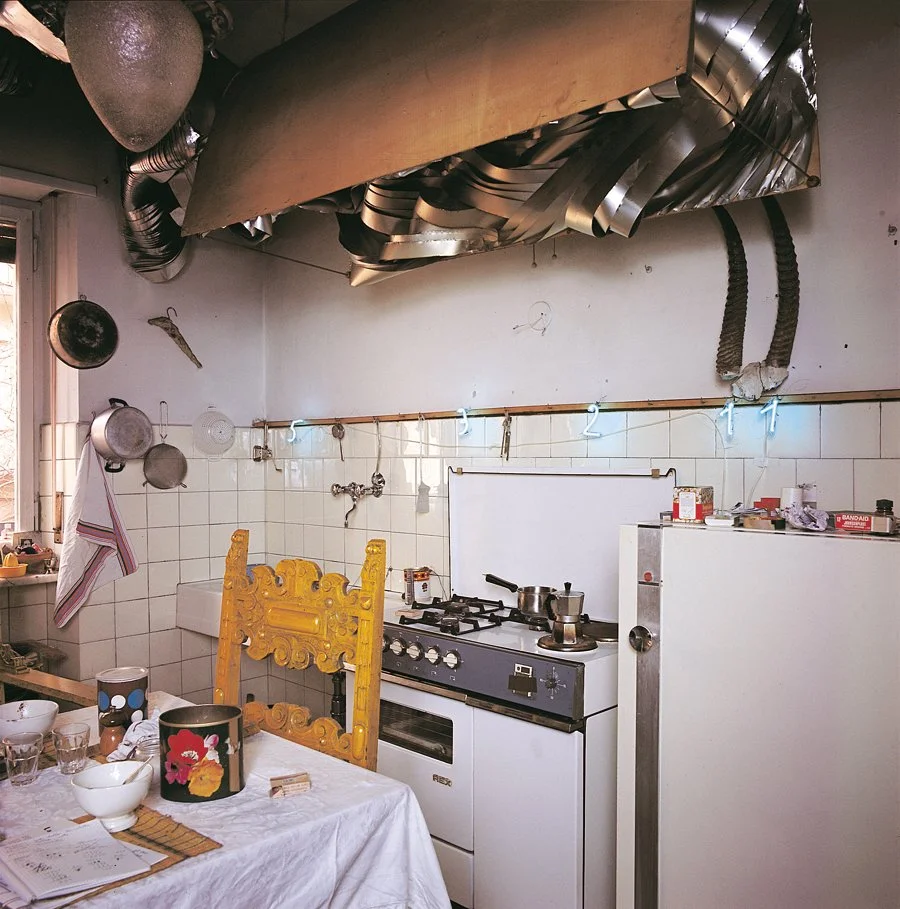
Mangini, Elizabeth. “Solitary/Solidary: Mario Merz’s Autonomous Artist.” Art Journal Open, October 28, 2016.
Marisa Merz (Turin, 1926–2019) was the only woman associated with Arte Povera — the Italian avant-garde movement that rejected the polished hierarchies of the art world in favor of raw materials and everyday gestures.
For years, she did not put herself forward as an artist. She did not participate in solo exhibitions or date her works. This was a deliberate inquiry into authorship and into what art could be when made outside the structures that determined its value.
Her home in Turin was her primary site of making. Around 1966, she began constructing massive, multi-part tubular aluminum sculptures throughout the apartment — suspended from ceilings, draped over the stove, inhabiting and sharing space with the family. Groupings of ceramics, waxed violins, and drawings rotated through the rooms in an ongoing installation that changed and evolved over time. The domestic environment was not a backdrop, but a living collaborator within her practice.
“Junk,” she referred to in conversation with German Celant, are “things that don’t have anything to say. But I hold onto them, because every once in a while, voilà — they become visible, they talk.”
Merz created a domestic vocabulary entirely her own. The act of living with materials, reworking them, allowing them to change form and meaning over time, was inseparable from the work itself.
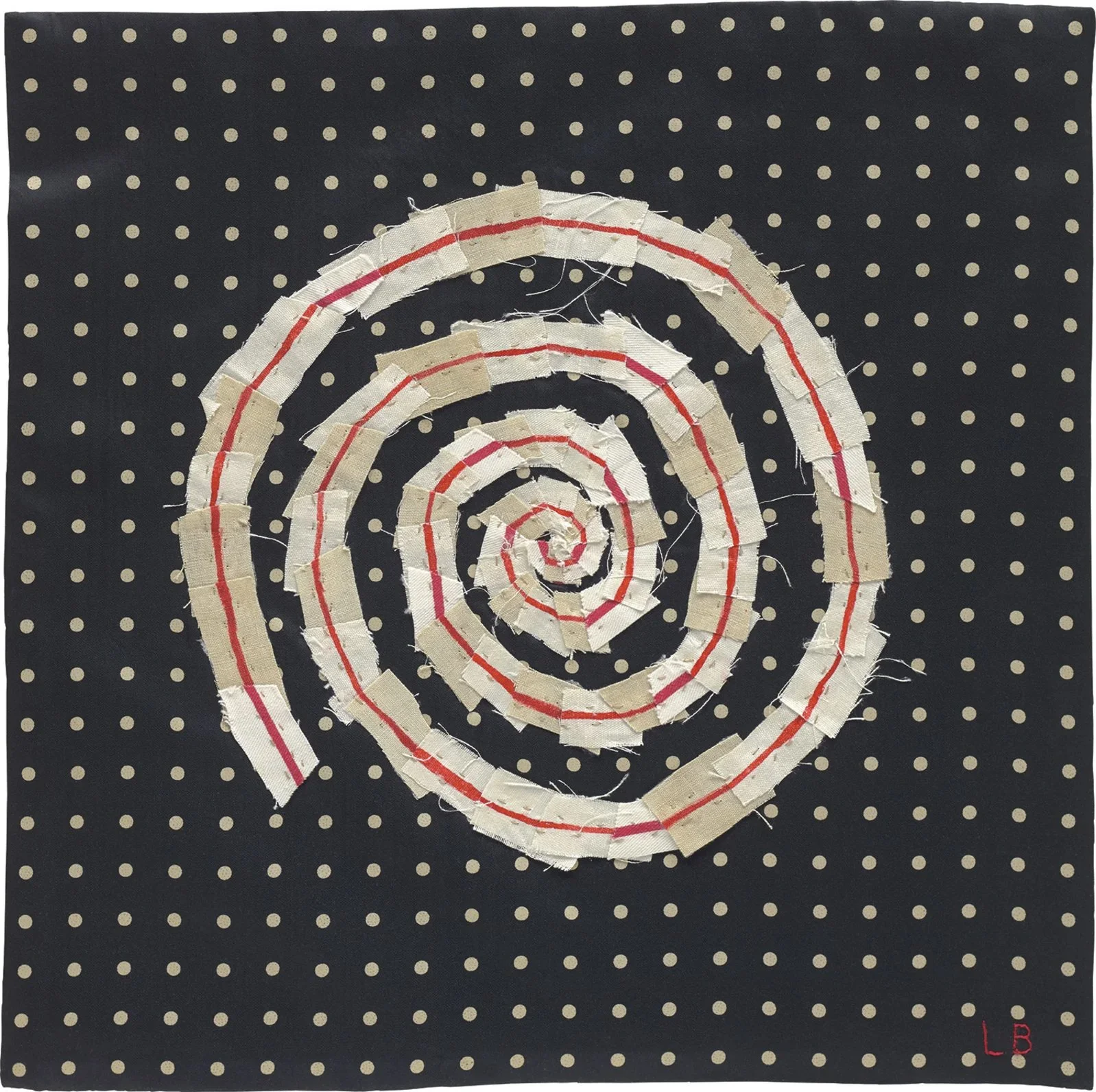
“Louise Bourgeois | Untitled (2006) | Art & Prints | Artsy.” Accessed May 4, 2026.
Known for her large-scale sculptures and installation art, Louise Bourgeois (1911–2010) spent a lifetime making work from the material of memory. Her process was fueled by an introspective reality, often rooted in cathartic re-visitations of early childhood trauma and frank examinations of female sexuality.
In the mid-1990s, Bourgeois asked her longtime studio assistant, Jerry Gorovoy, to bring down the contents of the upstairs wardrobes to her studio. The wardrobes, almost like time capsules, held garments dating to her childhood alongside clothing that had belonged to family members. She suspended the clothes from hangers on the ceiling pipes, opening a new and intimate dialogue with what they carried.
“You can retell your life and remember your life by the shape, the weight, the color, the smell of the clothes in your closet,” Bourgeois said. “Fashion is like the weather, the ocean — it changes all the time.”
Bourgeois understood that the domestic object is never merely functional. It is a repository — of presence, labor, and the invisible histories that accumulate in the things we live alongside. Working with these objects was not nostalgia, but an excavation of memory and a way of asking what the material world holds that language cannot say, and what it means to honor that holding.